Design Guide for Video Surveillance Systems in Explosion-Hazardous Environments
A comprehensive engineering reference covering camera selection, Ex protection concepts, fiber-first transmission, certified enclosures, grounding practices, OT network integration, and operational procedures for hazardous area video surveillance systems.
System Overview
Explosion-proof environment video surveillance is a specialized surveillance system intended for locations where explosive atmospheres may exist due to flammable gas, vapor, mist, or combustible dust — including petrochemical process units, tank farms, loading/unloading racks, hazardous chemical warehouses, dust workshops, coal chemical and pharmaceutical plants. The system must still meet the operational outcomes of "visible, clear, evidentiary, and linkable" — but its primary objective is to ensure that equipment, power delivery, wiring, termination, commissioning, and maintenance do not become an ignition source.
This guide covers camera selection, Ex protection concepts, in-zone installation constraints, fiber-first transmission, certified enclosures and junctions, grounding and lightning practices, power distribution and UPS, integration with OT networks, and operational practices. The guide is not applicable to consumer-grade CCTV, non-certified improvised "sealed boxes", or using surveillance as a safety instrumented function (SIF) with SIL claim.
Key inputs include HAC drawings, gas/dust group and temperature class requirements, site environmental constraints, camera coverage requirements, OT network constraints, retention policy, and integration needs such as F&G alarms, access control, and PA/GA systems. Outputs include a compliant architecture, device and cable schedules, Ex certificate pack, installation method statements, test and acceptance plans, O&M playbooks, and a documented responsibility boundary with F&G and process systems.
The core value of this design approach is a compliance-first deployment that minimizes in-zone electronics ("less equipment in hazardous zones"), uses fiber-first transport, and ensures an "end-to-end explosion-proof chain" from device to power, cabling, and termination. Key dependencies include hazardous area classification, electrical single-line design, grounding and lightning design, OT cybersecurity zoning, and a certified Ex equipment supply chain.
System Architecture
The overall reference architecture divides the plant into hazardous zones and a safe area. In hazardous zones, certified Ex cameras connect via fiber to Ex junction boxes, which route to the safe-area network room. The safe area hosts all active electronics including switches, firewalls, VMS servers, storage, and operator workstations. The architecture is organized into four distinct layers, each with defined responsibilities and interfaces.
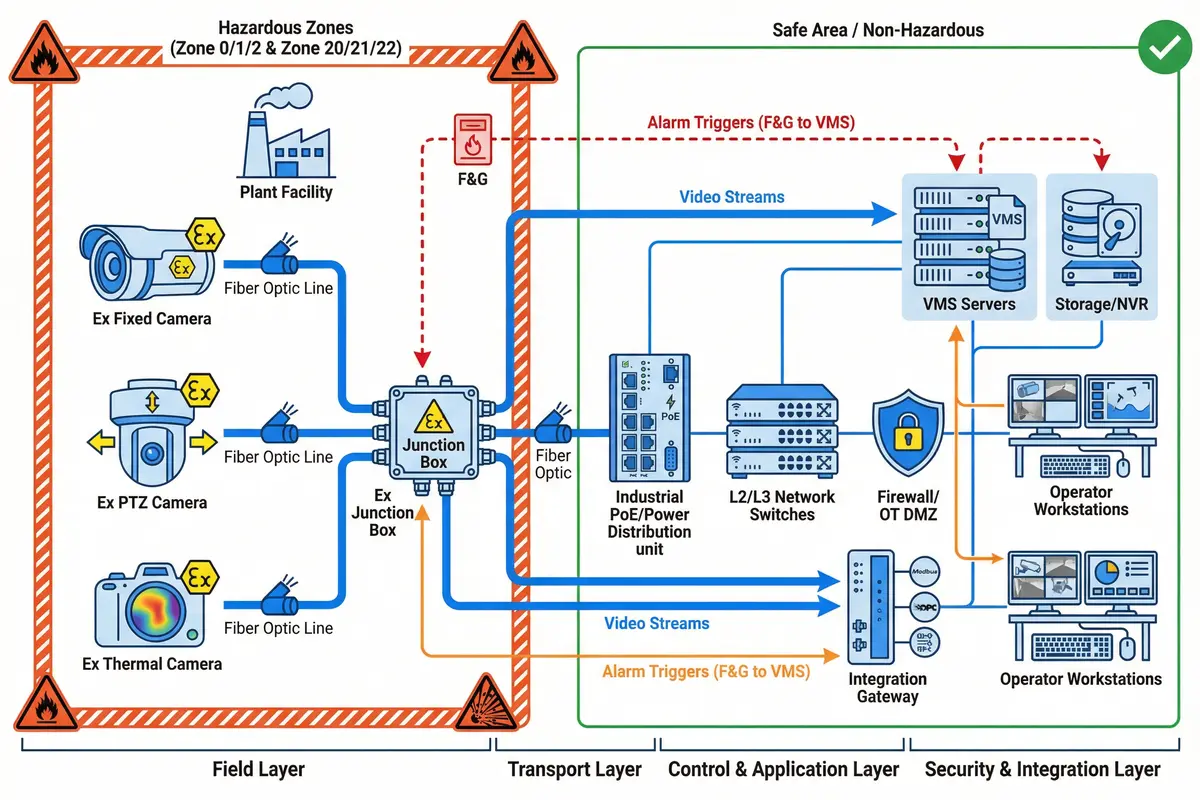
The layered architecture ensures clear separation of concerns. The Field Layer contains only certified Ex cameras, glands, and junction boxes with minimal active components. The Transport Layer uses a fiber backbone with redundant rings where needed. The Control & Application Layer hosts VMS, recording and storage, analytics, time sync, and user management. The Security & Integration Layer provides OT segmentation, firewall rules, event integration, and audit logs.
Main Functions
The VMS platform serves as the central hub connecting all surveillance functions. Seven core functions are provided, each with defined acceptance criteria and performance targets. The diagram below illustrates the functional relationships between the VMS platform and its connected modules.
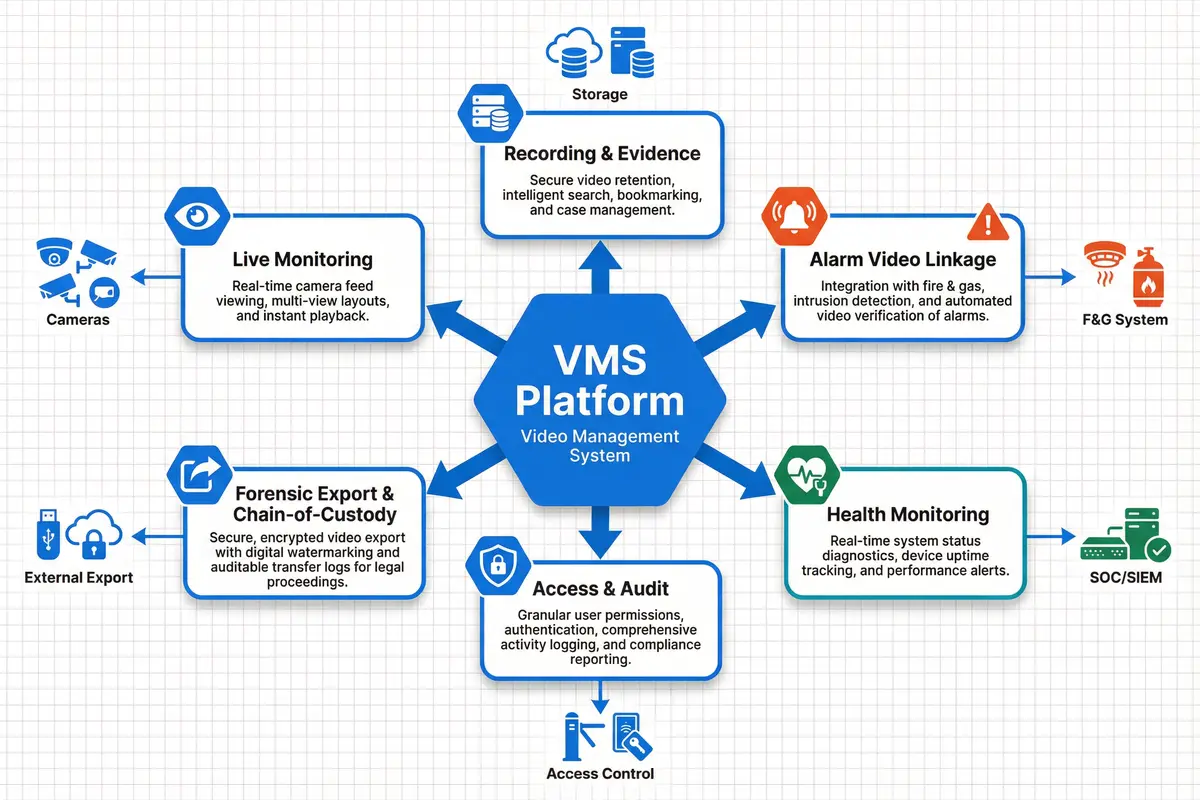
- Live Monitoring (Hazard Verification): Fast operator confirmation during alarms. Acceptance focus: latency, clarity, PTZ response time.
- Continuous/Event Recording & Evidence: Tamper-resistant recording with retention policy. Acceptance focus: dropped frames, timestamps, export integrity.
- Alarm Linkage with F&G/Fire/Process: Alarm triggers pop-up views, presets, and record-lock. Acceptance focus: correct camera mapping and response time.
- Device Health & Proactive Maintenance: Link status, temperature, and lens contamination alarms. Acceptance focus: accurate alarms and ticket workflow.
- Cyber Access Control & Audit: Role-based access, MFA where feasible, and immutable logs. Acceptance focus: least privilege and audit completeness.
- Forensic Export & Chain-of-Custody: Signed exports, watermark, and time sync. Acceptance focus: verification procedure.
- Optional Analytics (Safe-Area Compute Preferred): Intrusion in restricted zones, smoke/flame support (non-SIL). Acceptance focus: false positives and boundary conditions.
Chapter Navigation
This guide is organized into twelve chapters covering all aspects of explosion-proof video surveillance system design, from component selection through to operations and maintenance. Use the navigation cards below or the left sidebar to access any chapter.